Running Ten Agents Was the Easy Part
In February I released Parallel Code to fix one problem: waiting. One coding agent at a time is slow, so each task got its own git worktree and branch, and the agents ran side by side.
That part worked. Parallel Code 4 was built in Parallel Code: between version 1.10 in June and version 4.0 on October 10, 41 of the 44 branches I merged were Parallel Code tasks, 11 of them on October 9 alone. Eleven merged branches in one day also means eleven reviews. When several branches finish within the same half hour, the agents are no longer the slow part. Reading diffs, rerunning tests and deciding which work to trust is.
Most of what changed between version 1 and version 4 is about that second problem.
Understand the change before you read the diff
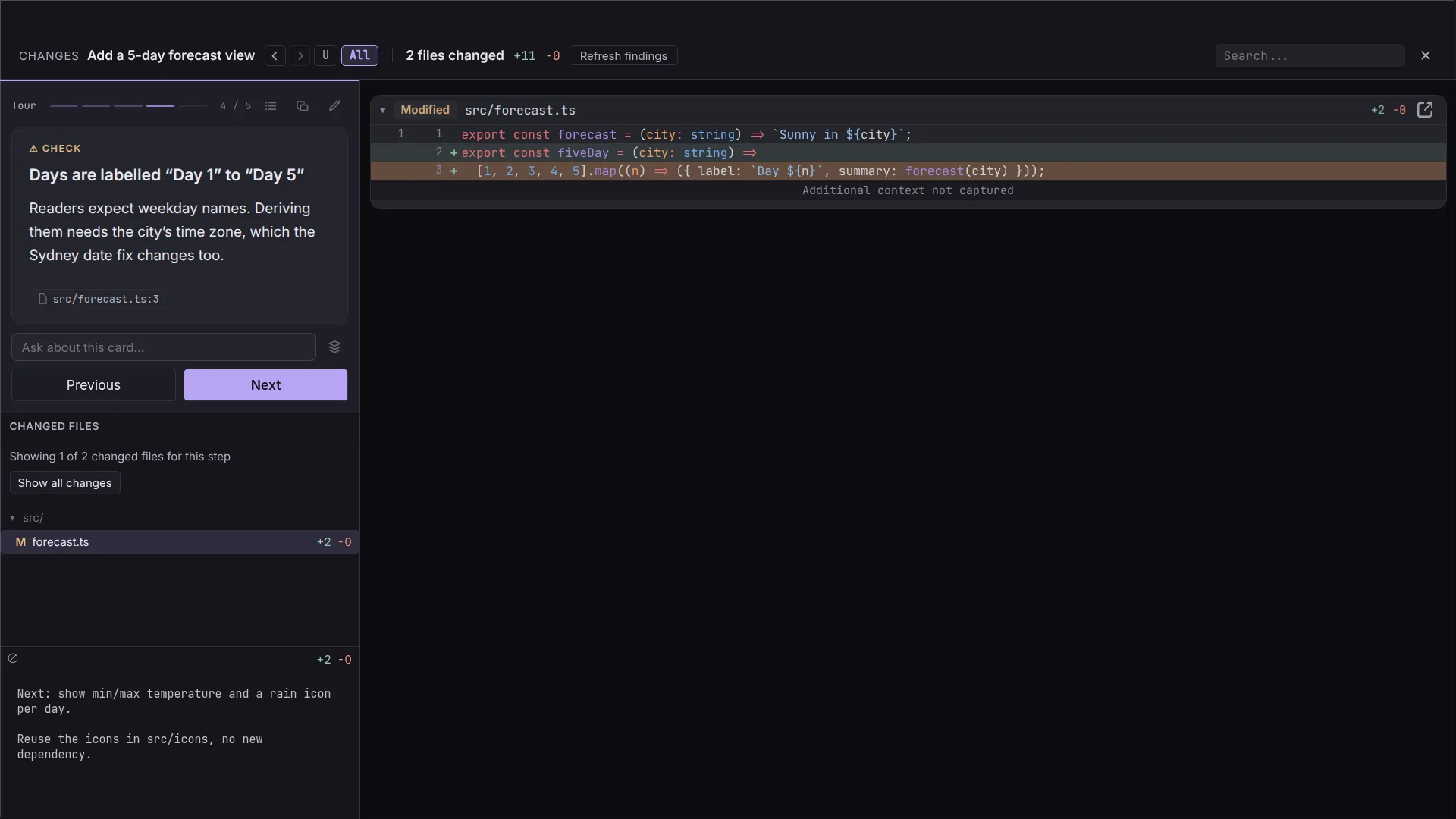
A change tour walks through a task’s diff in a few short stops, flags the risky or uncertain parts, and lets you ask follow-up questions on any stop. Plan and file tours do the same for an agent’s plan or a single changed file. Tours explain a change. They do not prove it works.
Evidence instead of “done!”
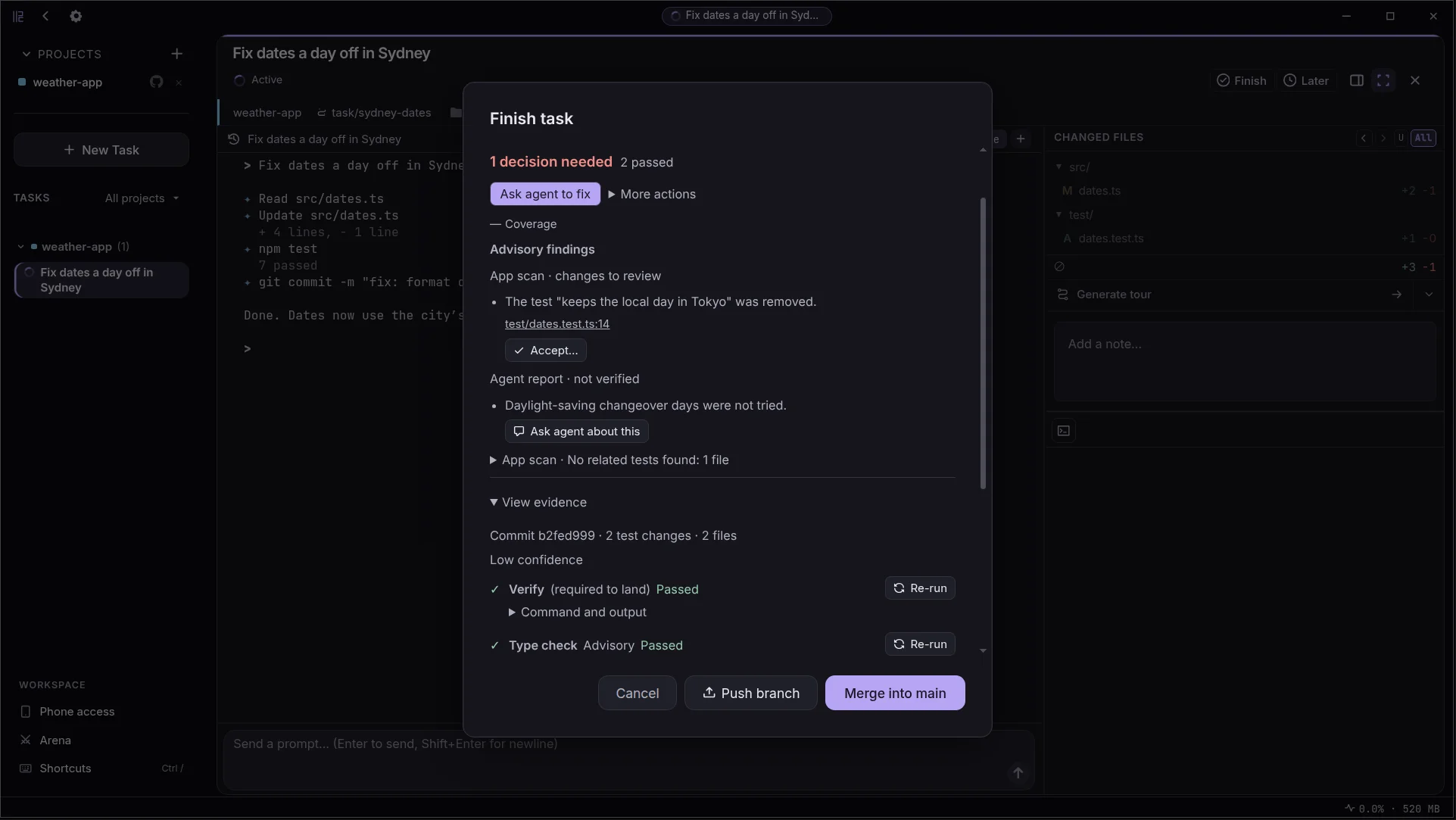
An agent saying it finished is a claim. Configure your checks once (tests, lint, type check), and an evidence package runs them itself, scans the change, and flags things like weakened tests or changed code without related tests. You build it from the Finish dialog, the agent can submit it over MCP when it hands off, and background builds are an opt-in project setting.
What the app observed, what the agent reported, and what an optional AI review thinks are labeled separately. The headline says what passed and what still needs your decision, never “correct”. Ask agent to fix sends failures back to the agent and asks for an explanation, never for weaker tests. If your project produces a coverage summary, changed files also get per-file coverage badges.
Agents that hand off work you can see
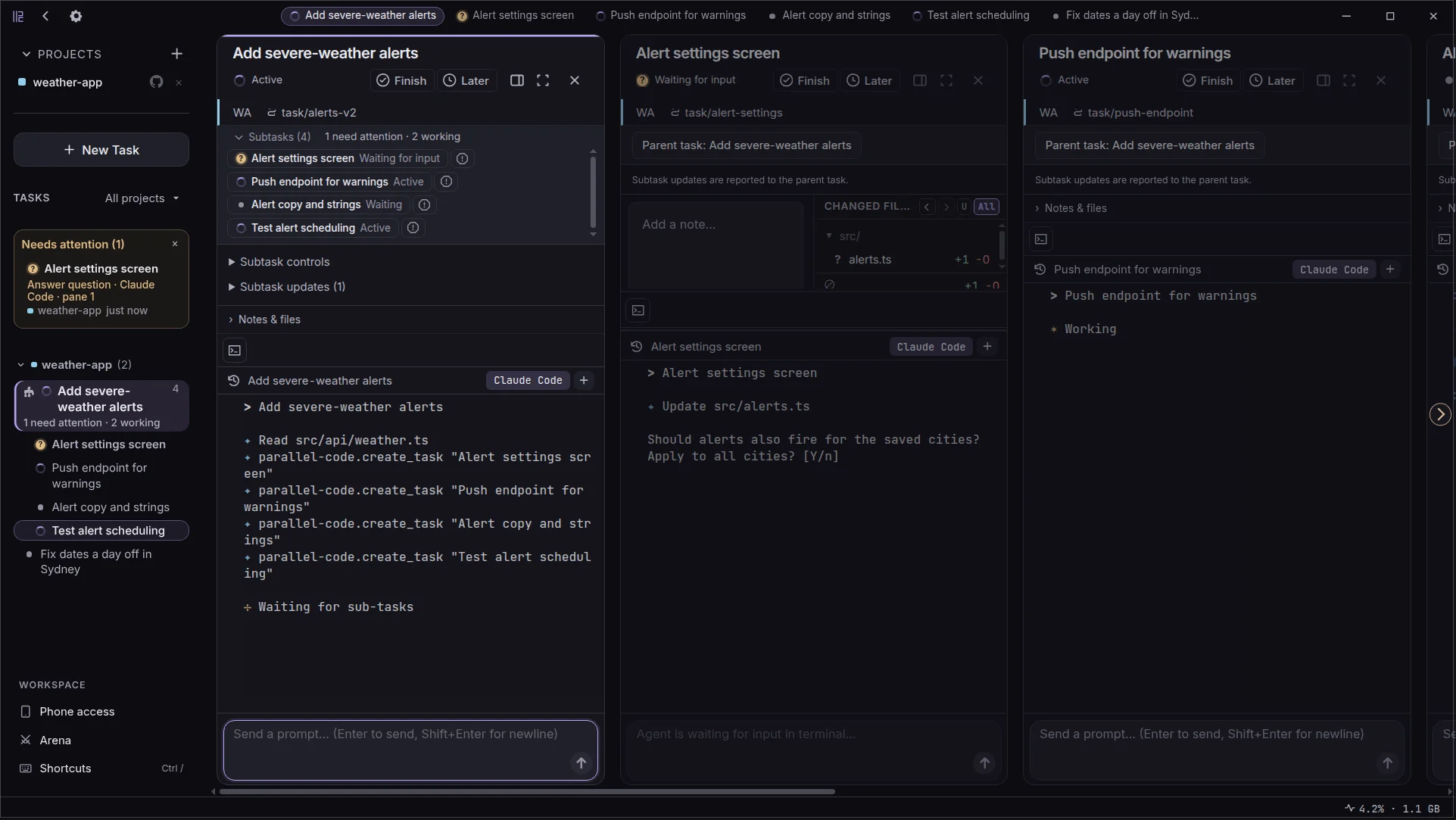
With orchestration on (the default, in Settings > MCP), an agent can split work into new Parallel Code tasks over the built-in MCP server. Each gets its own worktree and terminal and shows up in your sidebar, so nothing runs where you can’t see it. By default, tasks that need your input are listed first.
Step away without losing track
The new Android app notifies you when a task needs input. You can read the agent’s terminal and reply from your phone, including by voice, after unlocking replies with your desktop PIN. Parallel Code keeps running on your computer, and the phone reaches it on the same Wi-Fi or through Tailscale. The app installs from GitHub releases; it is not in the Play Store yet.
What hasn’t changed
Parallel Code still runs the real terminal CLIs (Claude Code, Codex CLI, Gemini CLI and other terminal agents) with your own accounts. It is free and MIT licensed, and runs on macOS and Linux. Tours and the optional AI review call your configured model, so they use your own agent usage.
What isn’t solved
Passing checks are not correctness, and a tour is an explanation, not a test. Evidence only covers the checks you configure, and re-running the suite on the merged result is still your job. There is no Windows build yet.
If you run several agents at once, I’d like to hear where your review time goes: open a discussion on GitHub or reply on the v4.0.0 release.